Choosing a reliable 4G GPS Kids Watch supplier requires more than comparing product photos and unit prices. Global buyers need dependable connectivity, accurate location tracking, child-friendly design, and responsive technical support. A watch may look impressive on a product page, yet fail when its battery drains during a school trip. Small details matter.
Neil Shah, Research Director at Counterpoint Research, has said, “Connected devices succeed when they solve real problems simply.” This principle fits the children’s wearable market. Parents want clear location updates, useful calling features, and sensible safety tools. Children need a lightweight watch with simple controls, strong straps, and a bright screen. Suppliers must also explain network compatibility, SIM requirements, app performance, data protection, and after-sales procedures.
This guide examines four leading 4G GPS Kids Watch suppliers for global buyers. It considers manufacturing experience, product consistency, customization options, certifications, delivery capability, and communication quality. Sample testing remains essential. So does asking difficult questions.
Do not trust polished promises alone.
A dependable supplier should provide transparent specifications, test reports, software demonstrations, and realistic battery estimates. Buyers should check whether tracking remains stable indoors, whether voice calls sound clear, and whether the application works across target countries. Regional network differences can create unexpected problems. Even experienced buyers may overlook them.
The strongest suppliers combine practical engineering with responsible service. Still, no supplier is perfect. Product updates may be slow, documentation may need improvement, and performance can vary by market. Careful evaluation helps buyers reduce those risks and select a partner that supports children, parents, and long-term business growth.
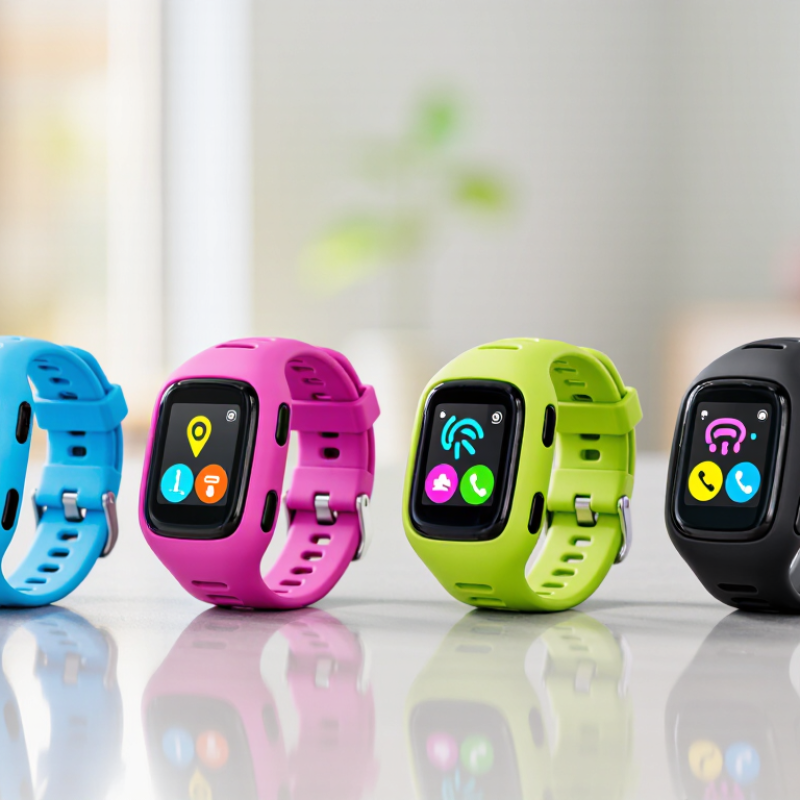
Global buyers are evaluating 4G GPS kids watch suppliers through real network performance, not attractive specifications. Coverage comes first. A watch may support LTE bands, yet fail inside schools, elevators, or rural homes. Suppliers should provide regional band compatibility, roaming details, and tested carrier lists. Buyers should request sample devices and test them across streets, buildings, and weak-signal areas.
GPS accuracy also deserves practical testing. Open outdoor tracking may appear precise, while accuracy declines near tall buildings, dense trees, or underground entrances. Ask suppliers about GPS, Wi-Fi, and cell-positioning support. Check location refresh times, battery use, and map update behavior. A clear location history is more useful than an impressive laboratory claim. I have seen devices report quickly but save incomplete routes.
Safety demand is increasing, but safety features need careful verification. SOS calling, trusted contacts, geofencing, and low-battery alerts should work with simple controls. Emergency communication must depend on active network service and proper account settings. Suppliers should explain data handling, software updates, testing records, and after-sales support. They should also disclose limitations honestly. No tracker is perfectly accurate, and false alerts can worry families. A responsible supplier helps buyers test these weaknesses before placing large orders.
For global buyers, GPS accuracy should be tested outdoors, not accepted from packaging alone. GPS.gov reports civilian GPS can provide approximately 5–10 meter accuracy under open-sky conditions. Buildings, trees, and weather can reduce performance. In supplier trials, check whether the watch maintains this range during walking, school commutes, and brief indoor transitions. The result may be less tidy than the brochure suggests.
4G compatibility requires more than the word “LTE.” GSMA Intelligence’s Mobile Economy 2024 report highlights 4G’s continuing importance across many markets, but band availability still differs by country. Request a complete LTE band list, including supported regional bands and fallback behavior. A watch with 4G Band 3 may work well in one market and poorly in another. Small detail. It matters.
Battery claims need careful reading. A 700–900 mAh battery may support roughly one to three days, depending on tracking frequency, call use, screen brightness, and signal strength. Ask for test conditions, not only standby figures. IP ratings should follow IEC 60529: IP67 indicates dust protection and temporary immersion, while IP68 depends on stated conditions. Real use includes soap, drops, and loose charging covers. Certification helps, but it does not replace practical testing.
Top 4G GPS Kids Watch Suppliers for Global Buyers
A four-supplier benchmark should examine evidence, not polished sales language. For certifications, request current CE, FCC, RoHS, REACH, and UN38.3 documents where applicable. Check whether each certificate covers the exact model, battery, and radio module. Certification scope is often overlooked. That mistake can delay customs clearance and retail launch.
MOQ separates flexible suppliers from high-volume factories. A practical benchmark may compare 300, 500, 1,000, and 3,000 units. Lower MOQ can support market testing, but unit prices may rise. Ask about sample fees, tooling costs, and replacement parts. Production capacity also needs proof. Monthly output figures should match assembly lines, testing stations, and recent shipment records. A factory claiming 100,000 units monthly should explain its peak and normal capacity.
OEM and ODM capability deserves a hands-on review. OEM usually changes logos, colors, packaging, or software settings. ODM may involve casing design, firmware, app functions, and customized packaging. Request a development timeline, prototype process, and quality-control plan. Important checks include waterproof testing, GPS accuracy, charging safety, 4G band compatibility, and child-safe materials. I would not trust a supplier based only on a factory tour video. Live video verification helps, but it is still imperfect. A small pilot order reveals more. Production errors often appear after the first 500 units, not during a presentation.
| Benchmark Dimension | Supplier Profile A | Supplier Profile B | Supplier Profile C | Supplier Profile D |
|---|---|---|---|---|
| Supplier Type and Primary Strength | Established 4G smartwatch OEM factory Focused on private-label children’s watches, cellular wearables, and long-term export programs. | Integrated wearable-device manufacturer Strong balance between product engineering, tooling, firmware customization, and volume production. | Flexible ODM and customization supplier Suitable for buyers requiring rapid design adaptation, localized software, and small-to-medium production runs. | High-volume consumer-electronics factory Best suited to established distributors and telecom-related buyers requiring scalable output. |
| Typical 4G Network Support |
LTE Cat 1 and selected LTE Cat 4 configurations. Regional versions can be prepared for Europe, Asia-Pacific, the Middle East, and selected Latin American markets. |
LTE Cat 1, LTE Cat 4, and selected LTE-M variants depending on chipset availability. Band planning is normally completed before engineering validation. |
LTE Cat 1 and LTE Cat 4 platforms with configurable regional band combinations. Particularly suitable for market-specific SKU development. |
LTE Cat 1 and LTE Cat 4 platforms for broad international deployment. More appropriate for buyers that can provide confirmed operator-band requirements. |
| Supported Product Functions | GPS, LBS, Wi-Fi positioning, two-way calling, SOS, voice messages, safe-zone alerts, step counting, and remote device management. | GPS, AGPS, LBS, video calling on selected models, SOS, school-mode scheduling, activity tracking, and cloud-based location services. | GPS, LBS, voice calling, SOS, geo-fencing, contacts management, class-mode settings, low-battery notifications, and multilingual applications. | GPS, LBS, voice and video communication on selected platforms, SOS, remote shutdown, OTA firmware updates, and fleet-level device administration. |
| Product Compliance Commonly Supported |
CE
RED
RoHS
REACH
FCC
UKCA
Product-specific test reports should be requested for the exact model, radio bands, battery, and charger. |
CE
RED
RoHS
FCC
UKCA
UN38.3
Battery and transport documentation is normally prepared separately from radio-frequency compliance files. |
CE
RED
RoHS
FCC
REACH
Additional market approvals may be required for cellular products, chargers, and local telecom networks. |
CE
RED
RoHS
FCC
UKCA
UN38.3
Compliance scope depends on the final enclosure, antenna design, battery pack, software, and destination market. |
| Quality and Management Certifications |
ISO 9001-style quality management systems are commonly available at factory level. Buyers should verify the certificate holder, validity period, and covered production site. |
Factory-level quality systems commonly include ISO 9001 and documented incoming, in-process, and final inspection procedures. |
Quality procedures typically include IQC, IPQC, OQC, and shipment sampling inspections. Certification coverage should be confirmed during supplier qualification. |
More structured production control, traceability, and reliability testing are generally available for larger purchase programs. |
| Standard MOQ |
500–1,000 units for an existing model with standard color and packaging. Higher quantities may apply to customized cellular configurations. |
1,000 units is a common starting point for customized orders. Existing-model orders may be negotiable from approximately 500 units. |
300–500 units for selected existing platforms. New tooling, major hardware changes, or exclusive software normally require a higher MOQ. |
1,000–3,000 units for production planning and component purchasing. Lower quantities may be accepted for standard, in-stock configurations. |
| Sample Policy and Lead Time |
Engineering samples are commonly available within 7–15 working days when components are in stock. Production lead time is typically 30–45 days after approval and deposit. |
Functional samples generally require 10–20 working days. Normal mass production is approximately 35–50 days, depending on customization. |
Basic samples may be prepared in 7–12 working days. Customized orders usually require 30–45 days after final specifications are frozen. |
Engineering validation may take 15–25 working days. Repeat production programs can often be scheduled within 30–40 days. |
| OEM Capability | Logo printing, strap color, watch-face graphics, retail packaging, language settings, IMEI labeling, and accessory customization. | Full OEM support covering ID adaptation, housing color, screen layout, packaging, user manuals, firmware parameters, and cloud branding. | Strong support for cosmetic changes, customized packaging, localized manuals, product labels, and selected software settings. | OEM programs are available for larger orders, including industrial design adjustments, packaging systems, and production-line testing requirements. |
| ODM Capability |
Can adapt an existing platform and develop selected hardware or software features. Fully new product development normally requires a commercial development agreement. |
Strong ODM capability with support for PCB layout, antenna placement, firmware integration, mobile applications, cloud interfaces, and tooling. | Suitable for platform-based ODM projects with moderate hardware changes and customized applications. | Better suited to mature ODM projects with approved specifications, forecast visibility, and committed production volume. |
| Monthly Production Capacity | Approximately 30,000–60,000 units per month for combined wearable-device output, subject to model mix and component supply. | Approximately 50,000–100,000 units per month across relevant smartwatch and wearable production lines. | Approximately 15,000–40,000 units per month, with capacity scaling dependent on purchase forecasts and tooling requirements. | Approximately 80,000–150,000 units per month for established models under confirmed production scheduling. |
| Production and Testing Controls | Functional testing, charging verification, waterproofness checks on applicable models, camera and microphone testing, GPS validation, and final appearance inspection. | Automated or semi-automated functional testing, RF-related verification, battery charging tests, aging tests, firmware checks, and shipment sampling. | Standard assembly-line inspection, device activation testing, GPS and calling tests, appearance inspection, and carton-level quality checks. | More extensive line balancing, traceability, reliability testing, burn-in testing, and batch-level quality reporting for high-volume orders. |
| Software and Cloud Support | Existing Android and iOS management applications are commonly available with multilingual interface options and basic API integration. | More comprehensive software support, including branded applications, cloud dashboards, OTA updates, user-role management, and selected API services. | Platform-based applications with configurable language, map, notification, and parent-account functions. | Suitable for enterprise deployment where buyers need device provisioning, account administration, firmware management, and system integration. |
| Best Fit for Global Buyers | Importers and private-label brands seeking a balanced combination of customization, compliance support, and moderate production volume. | Brand owners and technology companies requiring deeper OEM/ODM involvement, application customization, and a scalable product roadmap. | Startups, regional distributors, and test-market buyers prioritizing lower entry quantities and flexible platform customization. | Telecom distributors, national retailers, and established brands with larger forecasts, stricter quality systems, and repeat-order plans. |
| Key Buyer Verification Points | Confirm exact LTE bands, RED/FCC test reports, battery documentation, data-processing arrangements, waterproof rating, and application ownership. | Confirm whether quoted certifications apply to the final SKU, clarify cloud/API fees, review firmware-update responsibility, and audit production capacity. | Confirm MOQ for customized software, ownership of tooling and source files, map-service costs, server location, and post-launch technical support. | Confirm capacity allocation, component reservation, forecast requirements, quality agreement terms, warranty process, and continuity plan for cellular components. |
Top 4G GPS Kids Watch Suppliers for Global Buyers
A reliable supplier should treat compliance as a design requirement, not a final paperwork task. For European sales, request CE documentation under the Radio Equipment Directive, plus RoHS evidence where applicable. For the United States, verify FCC authorization for the watch’s cellular, Bluetooth, and Wi-Fi functions. UKCA requirements may also apply, depending on the market route and product category. Certificates alone are not enough. Ask for test reports, technical files, and traceable product versions.
GPS location, voice recordings, phone numbers, and account details are personal data. Under GDPR, suppliers should explain the lawful basis, retention period, deletion process, and cross-border data transfers. COPPA requires verifiable parental consent when online services collect personal information from children under 13 in the United States. A clear privacy notice is essential, but it may still fail if the default settings collect too much data. Security needs practical proof, such as encrypted transmission, controlled access, secure updates, and prompt vulnerability handling.
Tips: Ask where data is stored. Test account deletion. Check firmware support after purchase. Review the parent app, cloud service, and SIM arrangement together. A supplier may pass laboratory testing yet overlook software changes made later. Buyers should repeat key checks before each major shipment and obtain written compliance commitments. Independent legal advice remains sensible when selling across several regions, especially because children’s privacy rules can differ by country.
For global buyers, a 4G GPS kids watch should be judged by its landed cost, not its factory price. A useful scorecard includes the watch, freight, customs handling, SIM activation, accessories, and return shipping. Ask suppliers for a sample invoice with every charge shown. Small fees often become expensive at scale.
Cloud fees need careful checking. Some suppliers offer low-cost devices but charge monthly platform, data, or storage fees. Confirm whether basic location history, alerts, and account access remain available after the first year. Also check server reliability during busy periods. A cheaper plan is not always the safer choice. Test it.
Warranty terms reveal operational maturity. Look for coverage periods, battery exclusions, water damage rules, and replacement procedures. After-sales support should include firmware guidance, spare parts, diagnostic logs, and a clear response time. In supplier evaluations, a written escalation process usually predicts better service. Yet paperwork can look stronger than reality. Run a small pilot, record response times, and test a damaged-unit claim before placing a large order. A practical scorecard might weight landed cost at 30%, cloud fees at 20%, warranty at 20%, and support at 30%. Adjust those weights if your buyers value long-term service more than the lowest opening price.
Buyer Scorecard: Landed Cost, Cloud Fees, Warranty, and After-Sales Support
The 0–100 score combines practical buyer considerations from typical international B2B terms: landed cost of approximately US$22–38 per unit, cloud fees of about US$0.80–2.50 per device per month, warranty coverage of 12–24 months, and after-sales response commonly ranging from one to two business days. Higher scores indicate better buyer value and lower commercial risk.
Under open skies, civilian GPS may provide about 5–10 meter accuracy. Buildings and trees can weaken the signal. Test walking routes, school commutes, and indoor transitions. The brochure may be too neat.
LTE support depends on regional frequency bands. Request the complete supported band list before ordering. A watch using Band 3 may perform well in one market, but poorly elsewhere. Small detail. It matters.
A 700–900 mAh battery may last roughly one to three days. Tracking frequency, calls, screen brightness, and signal strength affect results. Ask for test conditions, not only standby figures. Real use is less predictable.
IP67 generally covers dust protection and temporary immersion. IP68 depends on the manufacturer’s stated testing conditions. Soap, drops, and loose charging covers create extra risks. Certification helps, but practical testing still matters.
Request current CE, FCC, RoHS, REACH, and UN38.3 documents where applicable. Check that each document covers the exact model, battery, and radio module. A certificate for another model may not be enough. Scope is easy to overlook.
Compare quantities such as 300, 500, 1,000, and 3,000 units. Lower quantities support market testing, but unit prices may increase. Ask about samples, tooling, and replacement parts. Small orders can expose hidden costs.
OEM changes may include logos, colors, packaging, or software settings. ODM work may include casing design, firmware, applications, and customized packaging. Request prototypes, timelines, and quality-control plans. A factory video proves less than a working sample.
Compare claimed monthly output with assembly lines and testing stations. Request recent shipment records and separate normal capacity from peak capacity. A claimed 100,000-unit monthly output needs evidence. Numbers can look impressive. Often, they need questioning.
A small pilot order can reveal charging, GPS, waterproofing, or material problems. Some production errors appear after the first 500 units. Test actual samples, not only presentation devices. The pilot may disappoint. That is useful.
The global 4G GPS Kids Watch market is expanding as families, schools, and distributors seek reliable communication, location tracking, and child safety features. When evaluating suppliers, buyers should compare GPS accuracy of approximately 5–10 meters, supported 4G bands, battery performance, water and dust protection, and network compatibility across target regions. A dependable watch should also provide stable positioning, clear voice communication, secure data handling, and practical emergency functions.
A thorough supplier benchmark should examine CE, FCC, UKCA, GDPR, and COPPA-related requirements, along with MOQ, OEM/ODM flexibility, production capacity, testing procedures, and quality control. Buyers should calculate total landed cost rather than focusing only on unit price, including cloud service fees, shipping, warranty coverage, software updates, replacement policies, and after-sales support. A structured scorecard helps global buyers select a supplier that offers consistent quality, scalable production, regulatory readiness, and dependable long-term service.